.jpg)
Usua U. Amanam, Ph.D.
August 17, 2026
Introduction to the Dolby Family Ventures Copper Series. Over the last several years, Dolby Family Ventures (“DFV”) has created a shortlist of critical materials we believe most important to the future global economy, which we envision will be increasingly decarbonized, electrified, and regionalized in its strategic supply chains. Our efforts have focused on identifying metals with structural supply/demand challenges, whose value chains require novel solutions for rebalancing. Copper sits at the top of that list. Copper’s value lies in its ability to combine many functional traits into a single material, including high conductivity, malleability and ductility, corrosion resistance, and closed-loop recyclability. As the metal has garnered increased attention, we felt it would be appropriate to share with a wider audience why we remain attracted to opportunities in a market we first invested in in 2018 and have expanded further into over recent years. This is a three-part series covering supply, demand, and innovation. The objective is to formalize perspectives, update references, and share our learnings from past efforts with fellow investors. We try to avoid duplicating arguments made in widely circulated briefs and reports like S&P Global’s Copper in the Age of AI (S&P Global, 2026) and, for brevity, do not discuss topics like midstream processing or recycling. We also recognize we are not the first investors to highlight this opportunity. Articles by firms like Extantia Capital and World Fund discuss the value chain and highlight how specific start-ups are addressing sector challenges. Others, including Andreessen Horowitz, have promoted thoughtful pieces by portfolio companies that do the same. Our approach in this series is to more systematically analyze the underlying drivers of primary supply and global demand trends to show why the projected gap cannot easily be addressed, and how venture capital can capitalize on this, while ultimately promoting a more fluid and accessible copper market.
Summary of Part 1. Part 1 explains why we believe copper has the most durable demand-side story of various critical materials. Its superior end-use diversification and GDP-driven growth mean demand is highly resilient, putting unending stress on supply. Projections show this leads to a deficit, the magnitude of which is larger, in both absolute and percentage terms, when measured against other materials. We end by making the case that material substitution is unlikely to occur at a magnitude necessary to matter. In Part 2, we examine the long-term, supply-side trends that, taken together with what we have discussed here, create the conditions for the increased adoption of innovative solutions.
Setting the Stage. Economic opportunity arises when demand outpaces supply, and the durability of the factors influencing that behavior is critical in decision-making for early-stage venture capital for two reasons. First, the companies in which we invest take time to grow into businesses capable of addressing global commodity challenges. Second, we desire problems that cannot easily be solved by conventional means, and whose persistence indicates a need for a novel approach. Thus, we discuss the factors that, when taken together, influence our view of durability; they include demand diversification, the magnitude at which projected demand outpaces supply, and the materiality of substitution risk.
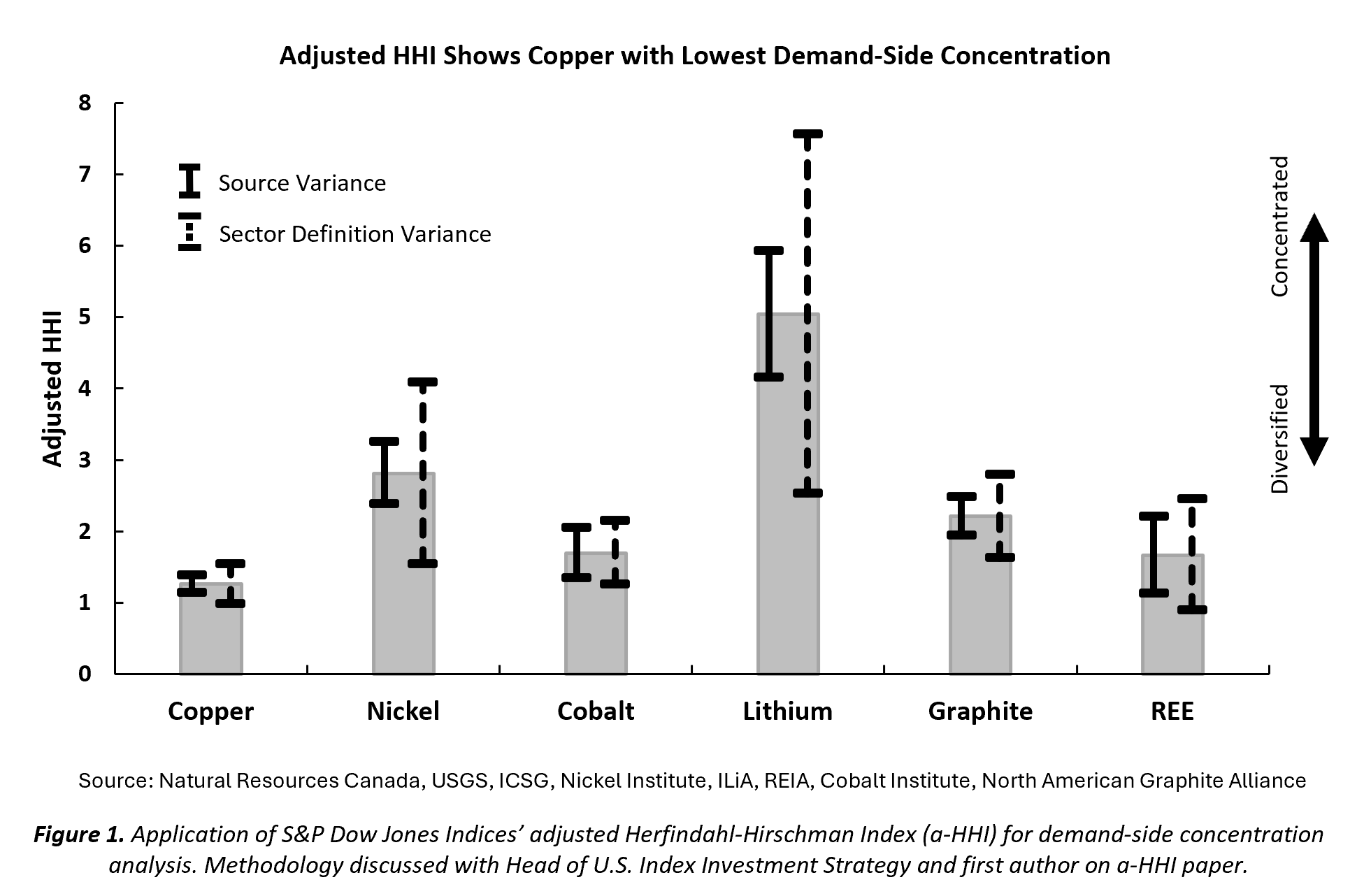 Demand Diversification and Resilient Growth Driver. Diversification across end-use sectors makes a metal more “resilient and less exposed to single point failures of demand” (BHP, 2024). This type of diversification is widely accepted for copper, even if only qualitatively, but it is less well understood for other metals. Below, we quantitatively rank demand-side diversification to help with prioritization, using the adjusted-Herfindahl-Hirschman Index (a-HHI) developed by the S&P DJI Index Investment Strategy team. This metric measures end-use concentration risk and controls for the variability in data granularity across sources (S&P Global, 2022). In Figure 1, a-HHI is calculated for six key minerals highlighted by the International Energy Agency (IEA) in recent editions of its Critical Minerals Outlook (IEA, 2025). Across multiple datasets and a sensitivity analysis, copper shows the lowest concentration. Meaning, slowdowns in any given end use have a more muted effect on overall demand, and by extension the projected supply/demand imbalance, than they would for other metals. But why should this matter if DFV remains confident in the primary demand accelerant for most of these critical materials: the energy transition? If the transition proceeds slower than projected, whether because of policy reversals or implementation drag, the magnitude of the problem we are trying to solve shrinks, with direct implications for supply-side innovators and their backers. This is particularly relevant in the US today, as well as in other regions.
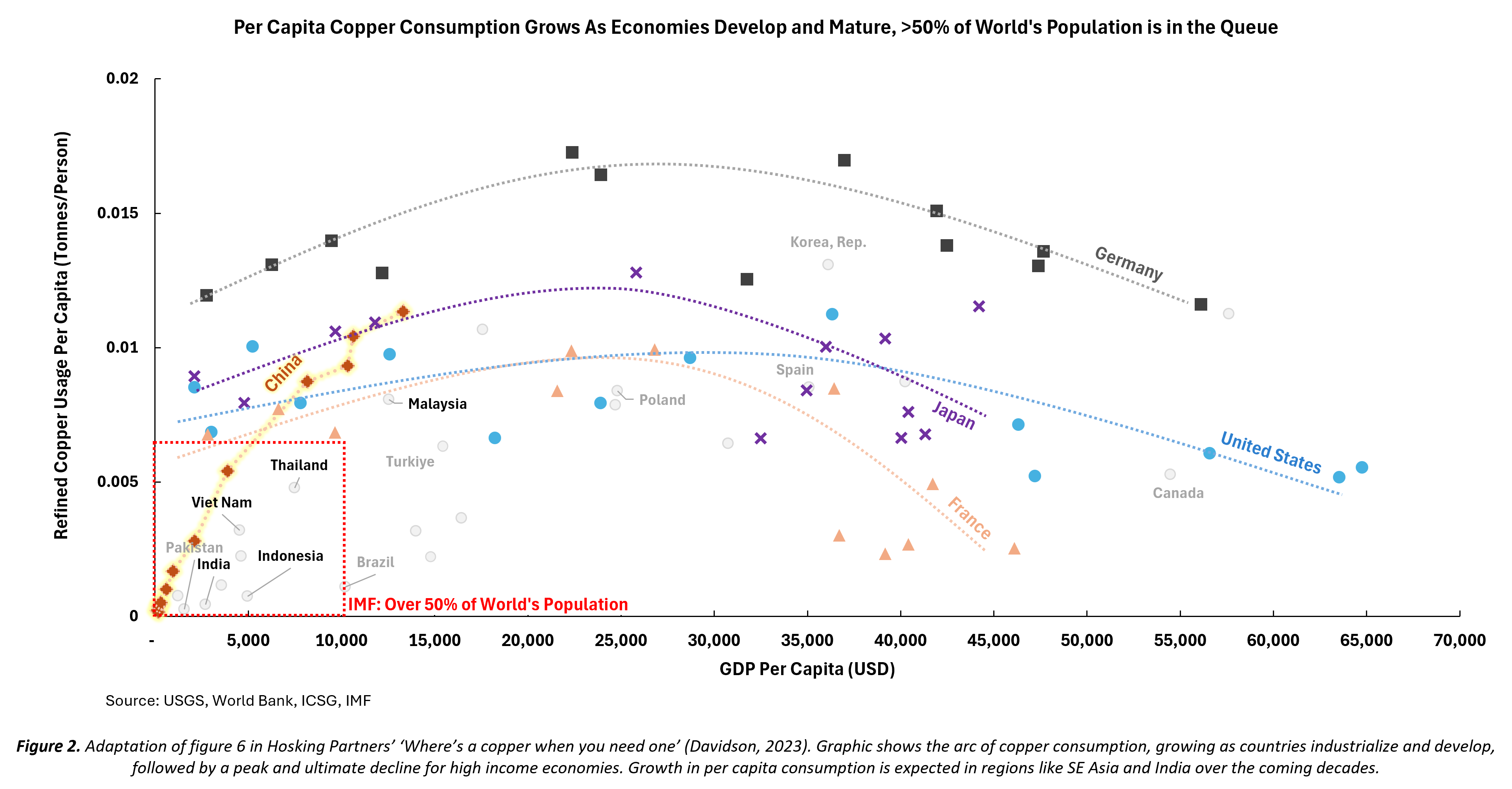
Copper’s diversification ties its demand more closely to general economic development than others, giving it a highly certain, long-term growth driver. In short, as countries develop, per capita copper consumption increases. This is most evident in China, where its dramatic GDP growth since the 1990s has made it by far the largest consumer of copper globally. While the future rate of China’s growth is uncertain, we are confident that the phenomenon will persist across populous regions such as India and Southeast Asia, which are earlier in their respective development timelines. Figure 2 is an analysis we did, showing the copper consumption arc that economies experience as they develop and mature. Importantly, more than half of the world’s population lives in regions that have not yet seen significant per capita GDP growth. While other critical metals may reflect this well-known pattern, not all that do meet other ‘durability’ criteria. For example, lithium demand is highly concentrated in electric vehicles and stationary storage. As a result, even though use may be positively correlated with economic development, growth prospects for that metal are most strongly tied to the behavior of two end-use applications, not the broader global economy1.
As a final note, as US supply-chain policy increasingly focuses on domestic supply/demand dynamics, it is worth recalling that copper, like any commodity, trades in a global marketplace. Overall demand, regardless of where consumption occurs, affects local prices and availability. Thus, we typically view these markets through a global and/or allied-nations lens.
 Magnitude of Forecasted Demand Outpacing. The larger the delta between forecasted supply and demand, the more attractive the opportunity for our capital. Various research organizations, such as S&P Global, IEA, and BNEF, publish projections using distinct methodologies and future demand scenarios that help us determine what this looks like for different critical materials. In Table 1, we present projections from the IEA’s 2025 Stated Policies Scenario (IEA, 2025), which shows copper running at a market deficit in both the near and long term. Not only that, but copper will have a larger gap to close, as a percentage of overall demand, than most other critical materials. BNEF’s 2024 projections show similar relational trends across the six materials, while standalone reports by Wood Mackenzie and S&P Global also highlight what is shown here (Wood Mackenzie, 2025a; Wood Mackenzie, 2025b; Wood Mackenzie, 2025c; S&P Global, 2026). We believe that the more pronounced the shortfall, the more incentivized stakeholders will be to solve the problem with novel approaches and/or innovations, and the more insulated an investor will be from shocks that eliminate the opportunity2.
Immaterial Substitution Risk. Material substitution is a demand-side phenomenon that reduces projected deficits and, by extension, the investment case for supply-side solutions. Understanding what that looks like for the critical materials in consideration is therefore important. However, forecasting material substitution is an imprecise, qualitative exercise. In fact, in the national/regional critical minerals strategies we reviewed, the term “subjective” is used more than once in methodology sections. In addition, substitution is bidirectional, meaning that a material that is substituted for in one instance may serve as the substitute in another, further complicating the matter. For example, restrictions on the use of lead solder in printed electronics within the EU (2003), as well as the mandate to replace lead pipes in drinking water systems across the US (2024), only stand to increase the use of copper in those applications over time, since it is a substitute of choice. In Table 2, we normalize substitutability data from four reports to show the high degree of variance across credible sources and ultimately to make the case that recent empirical data is likely sufficient to determine substitution risk in the future.

The existence of long-used copper substitutes, like aluminum and cross-linked polyethylene, provides enough of a historical basis to answer whether substitution matters on a timeline relevant for us. We do not think it does. Frank Messner conducted an in-depth study on the dynamics of copper substitution. In it, he argued that “material substitution is an evolutionary and path-dependent process,” not merely a function of relative price (Messner, 2002). His conclusion is consistent with the findings of other researchers. In a comprehensive review of substitutability across over 60 materials, a team from Yale shows how much substitution risk varies by application, complicating efforts to predict what overall substitution could look like for a metal (Graedel et al., 2015). Here, again, the importance of demand-side diversification becomes evident. Constraints and performance needs vary by use case, and by extension, so does substitutability. 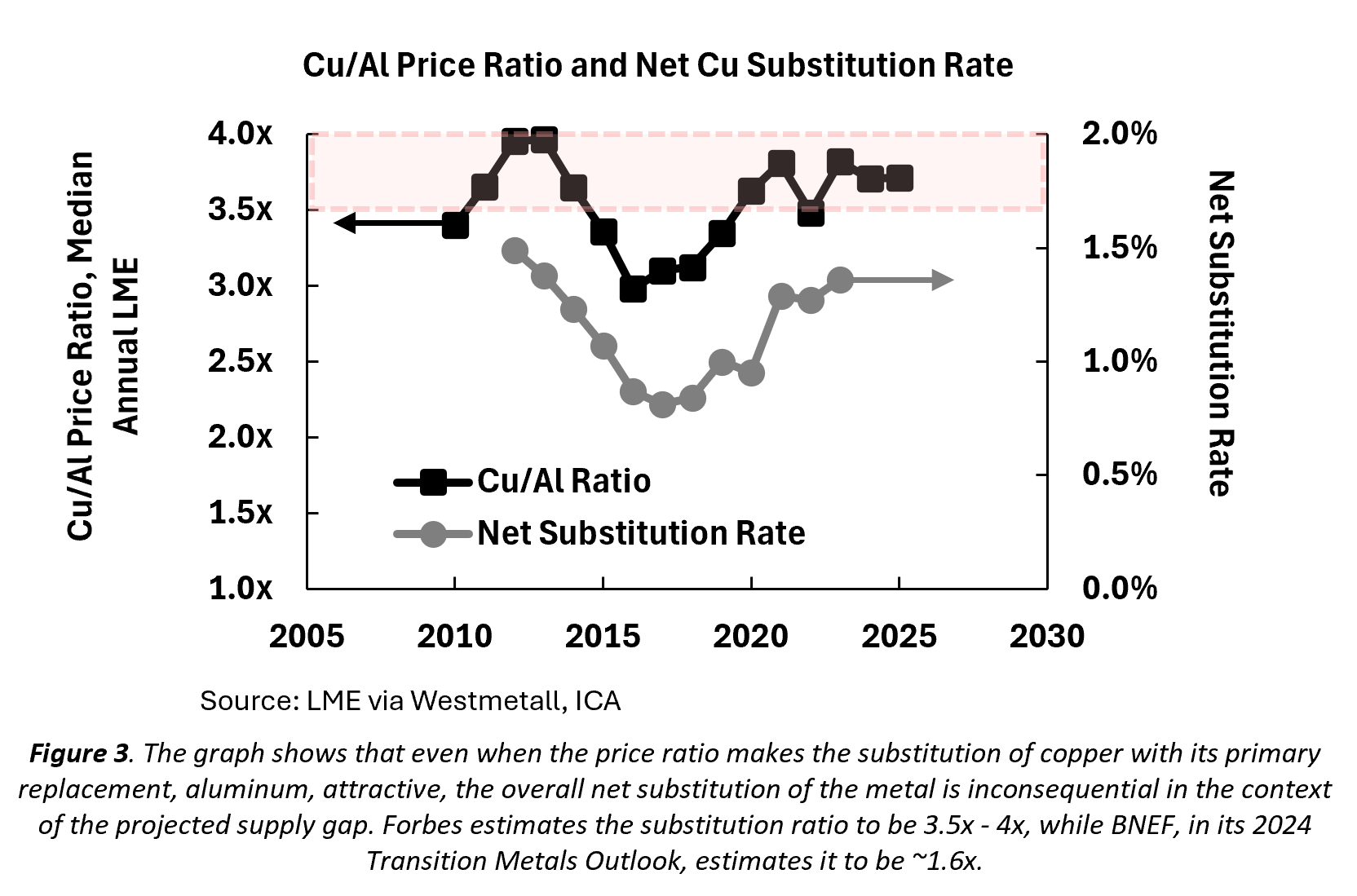 In the context of copper, one expert with whom we spoke frames this as a marginal cost-of-substitution curve, one in which the easiest substitution decision is made first and subsequent ones get progressively harder. Most simply, this can be seen in the increase in the copper-to-aluminum price ratio required to trigger more substitution (BHP, 2024). Figure 3 shows data with which some will be familiar. It presents the copper-to-aluminum (“Cu/Al”) price ratio from 2010 to 2025, with the net substitution rate for copper overlaid. What is most important about this graph is not the expected positive correlation, but that the absolute net substitution rate is nominal relative to the projected supply deficit in future scenarios. If, in times when the primary substitute is favored due to price, we would expect consequentially high substitution rates, and that has just not occurred. Over the past decade-plus, historically high Cu/Al price ratios have translated to no more than low single-digit rates, which, for us, implies that the risk is inconsequential. We estimate that in 2009, in the midst of the last supercycle, the rate peaked at <3% (Anglo American, 2021). In summary, substitution is a complex, multi-variable process that is more challenged when end-use demand is diversified. For long-established primary substitutes, such as aluminum, recent empirical data indicate that substitution is unlikely to close the projected supply/demand gap in any material way.
Conclusion. Some critical materials are more important to the future of the global economy than others. Some are also more compelling for early-stage investors. We argue that copper has the most attractive demand-side characteristics of a cohort of metals often cited as vital to the energy transition. These dynamics and the momentum of the trend suggest an increasing opportunity over the coming years. As early-stage investors, we require durable trends in the sectors we invest in as a critical input for decision-making. We show that copper has that by measuring the breadth of demand-side diversification, the magnitude of the projected supply/demand deficit, and assessing the muted risk of material substitution. When coupled with supply-side limitations, which we discuss in Part 2, we believe copper offers the most appealing opportunities to us as early-stage venture capital investors.
- We believe that despite this, the opportunity in lithium is compelling, and as such, it is also on our shortlist. ↩
- The story of Indonesian nickel over the past ten years is both a cautionary tale of how quickly market shifts can render in-flight innovation obsolete and one that shows how impactful a different approach to processing ore (high-pressure acid leaching) can be on a market (Brunelli et al., 2026). We explore novel ore processing technologies in Parts 2 and 3. ↩